True Colors, a found composition photographed by Jussi Koria

Jussi Koria presents

SDWLK ART -The Art ofSeeing the Unseen

The art was
already there.

View the artworks

True Colors, 2017

01 / The idea

Found,
never fabricated.

SDWLK ART (pron. sidewalk art) begins with accidental images hiding in plain sight: cracks, paint, corrosion, shadows, and discarded material. Jussi Koria discovers a composition, frames it with a camera, and gives it a title. All images begin as original photographs made by Jussi Koria; scenes are found, not staged, altered, or assembled. Nothing is painted or arranged.

The title is the second act of creation. It directs perception without changing the subject. What first appeared random becomes a face, a memory, an idea, or a cultural reference. Once seen, it is difficult to return to seeing nothing.

Location as evidence

Every artwork begins somewhere.

Every artwork can be geolocated to the precise place where it was discovered. The complete archive spans more than 15 cities in 10 countries, connecting each finished photograph to an ordinary, real-world surface.

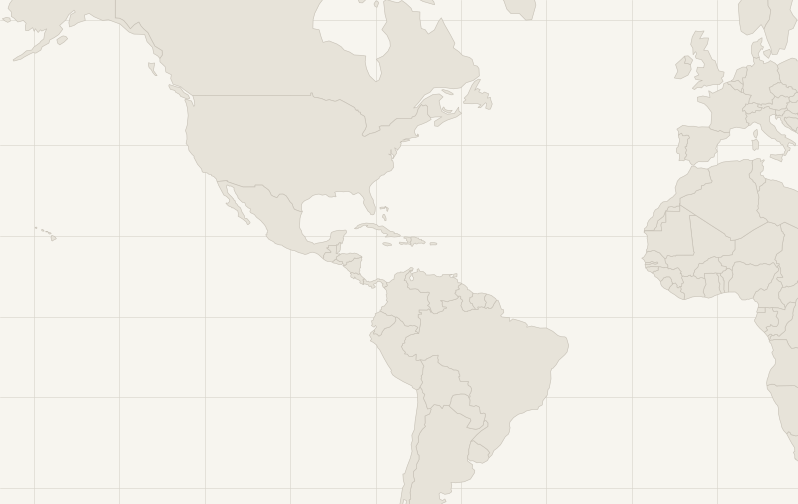
World map centered on the Americas
San FranciscoTrue Colors2017
AtlantaXochipilli2021
AtlantaMaharaja2025
Rio de JaneiroLava2018
Rio de JaneiroVideo Game2017
Rio de Janeiro1:552015

Six artwork discovery locations across San Francisco, Atlanta, and Rio de Janeiro.

02 / Selected artworks

Six discoveries.
Six complete stories.

Chosen from a wider archive, these six artworks demonstrate the range and consistency of the SDWLK ART method. Discovered in San Francisco, Rio de Janeiro, and Atlanta, they emerge from paint, rust, stone, water, pavement, and walls. Each begins with an ordinary surface, but framing and title open a different field of recognition: color becomes identity, corrosion becomes landscape, markings become a game or a clock, and natural or weathered forms become figures. Together, they show that the project is not defined by one place or subject, but by a sustained practice of attention, documentation, and resignification.

01

True Colors

San Francisco · 2017
True Colors by Jussi Koria
The artwork

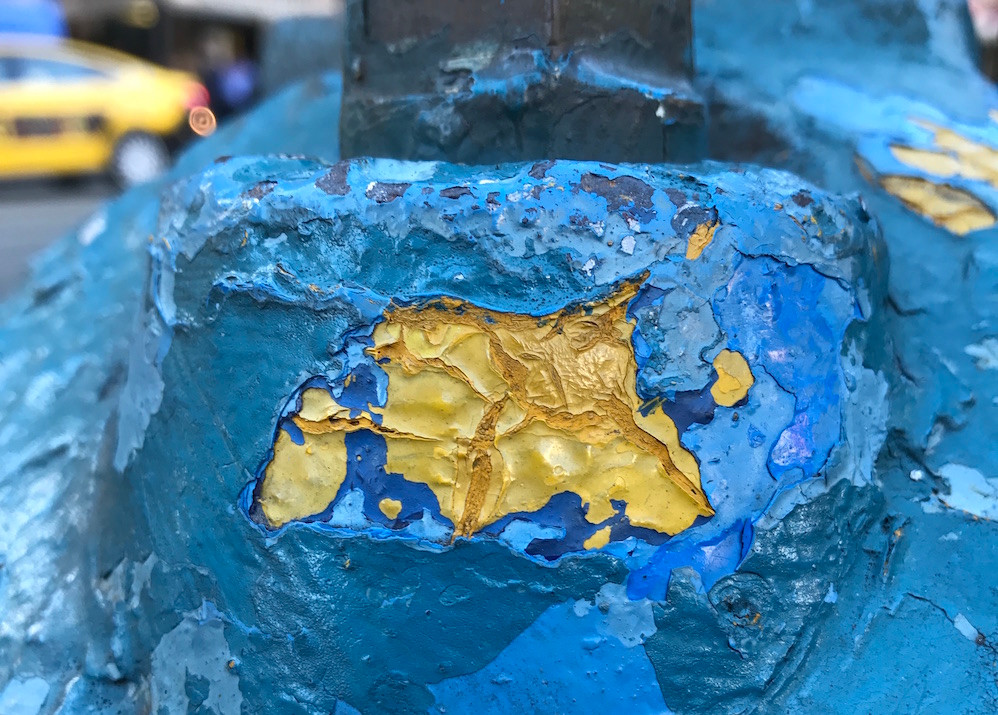
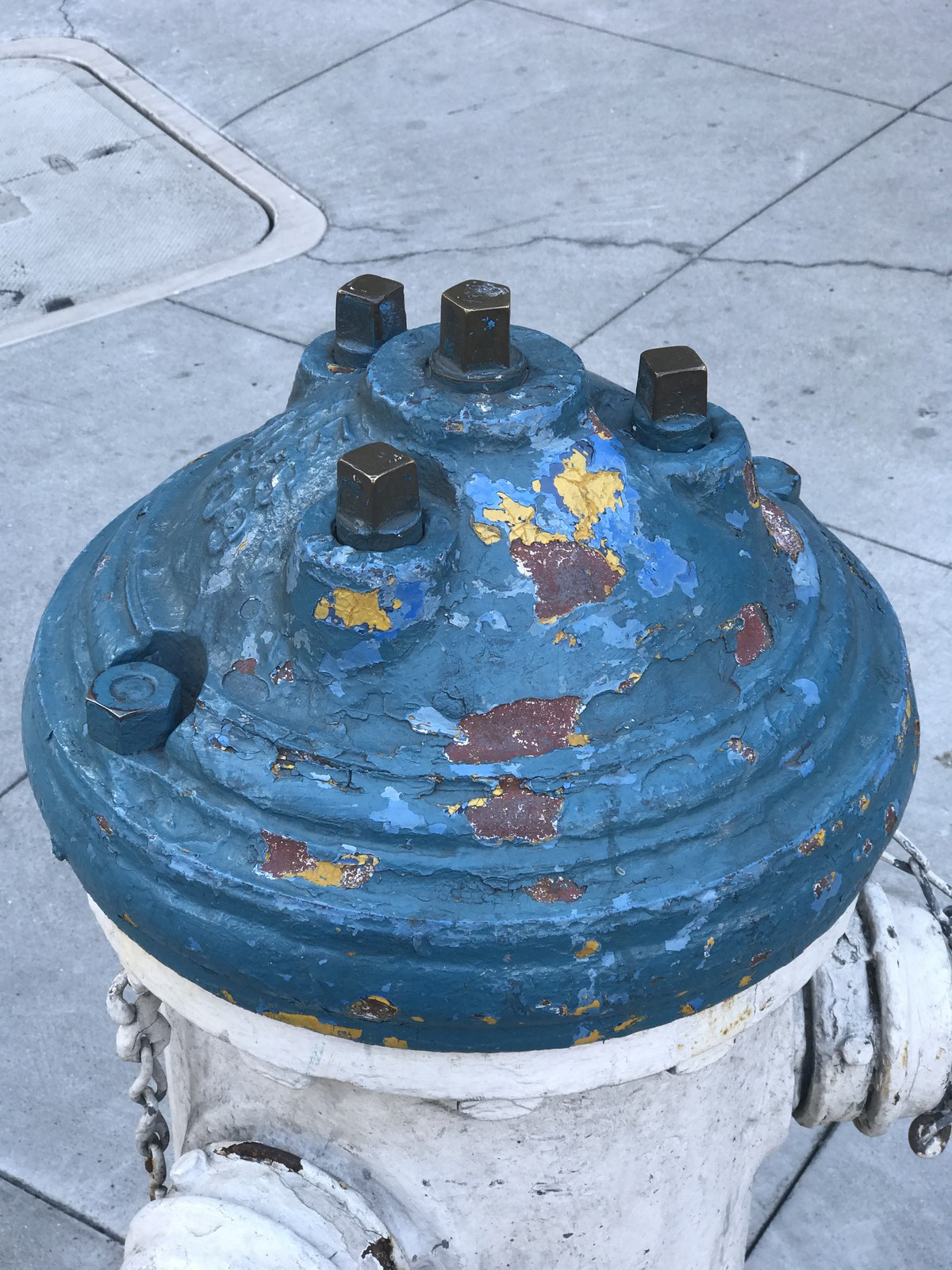
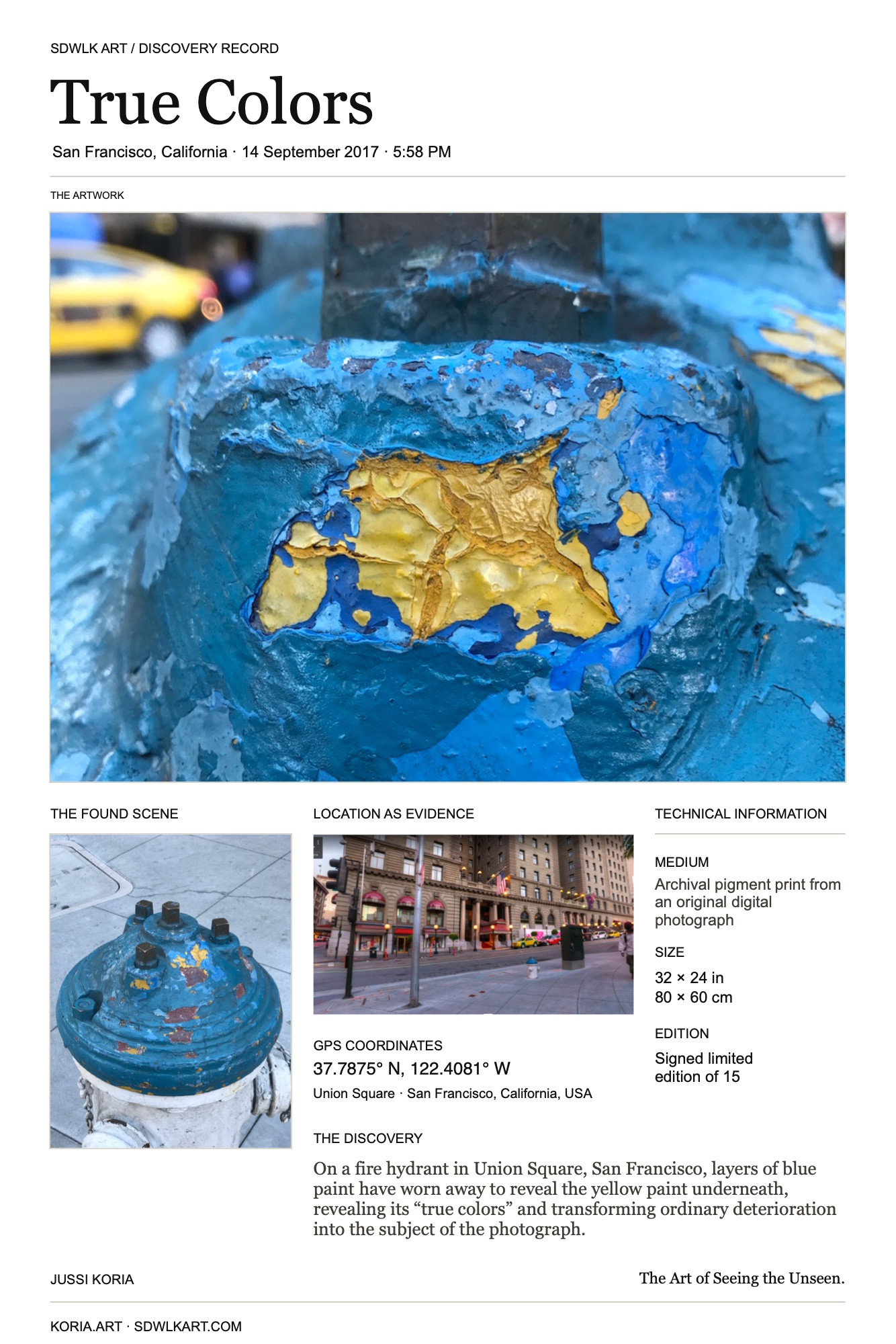
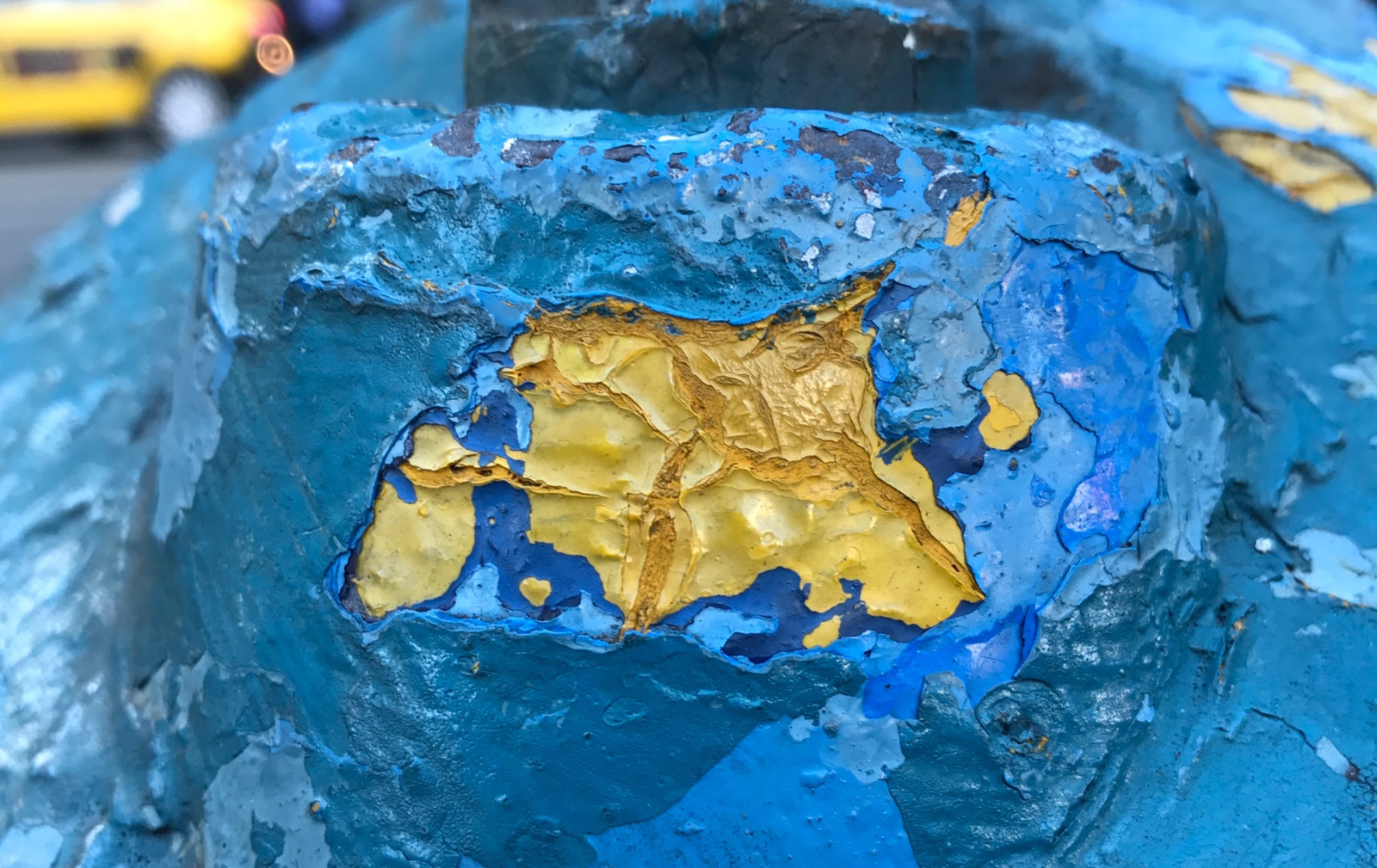
On a fire hydrant in Union Square, San Francisco, layers of blue paint have worn away to reveal the yellow paint underneath, revealing its “true colors” and transforming ordinary deterioration into the subject of the photograph.

Medium
Archival pigment print from an original digital photograph by Jussi Koria.
Dimensions
32 × 24 in / 80 × 60 cm
Edition
Signed limited edition of 15
The fire hydrant where True Colors was discovered
The found scene
True Colors discovery record and location map
Discovery Record

02

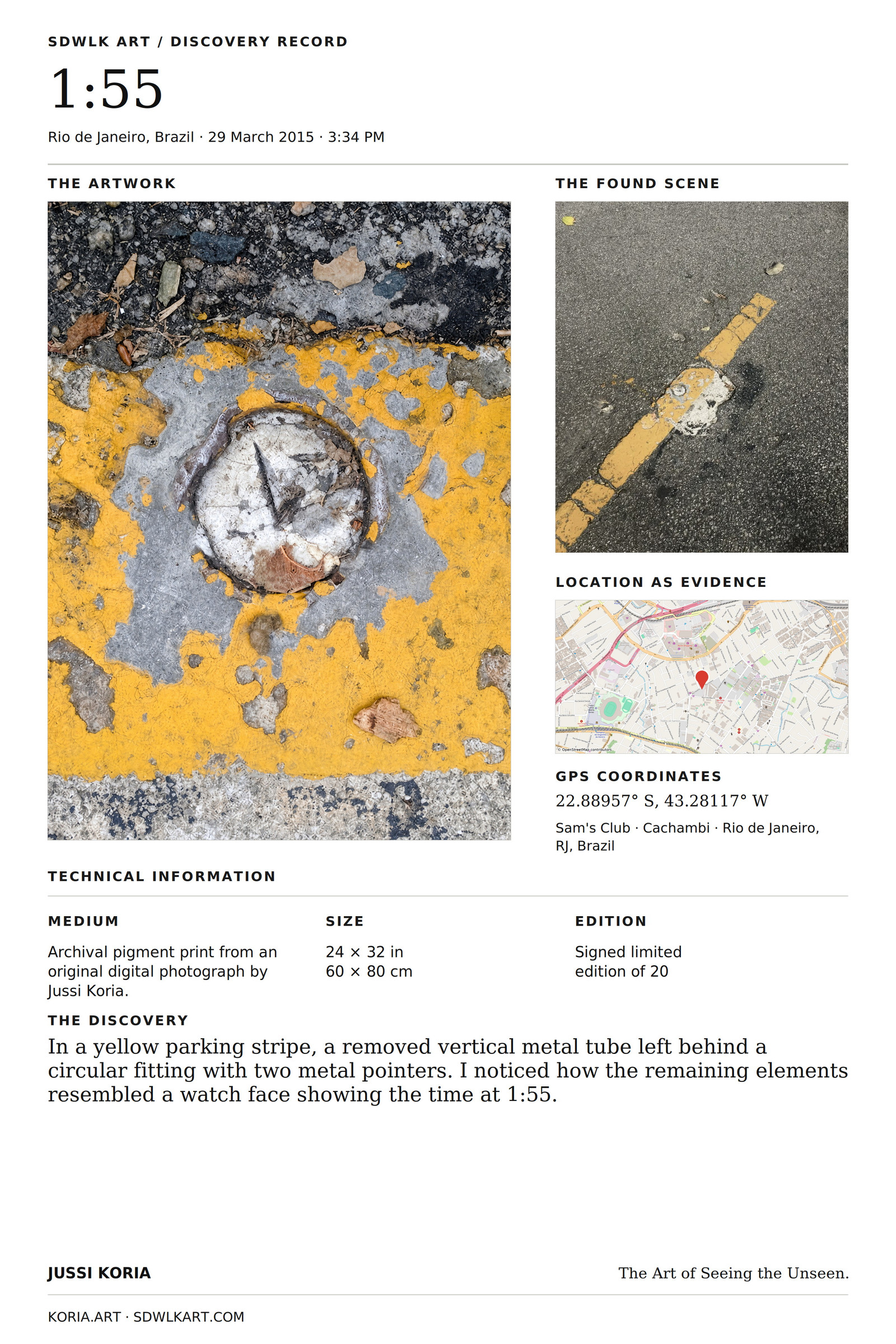
1:55

Rio de Janeiro · 2015
1:55 by Jussi Koria
The artwork

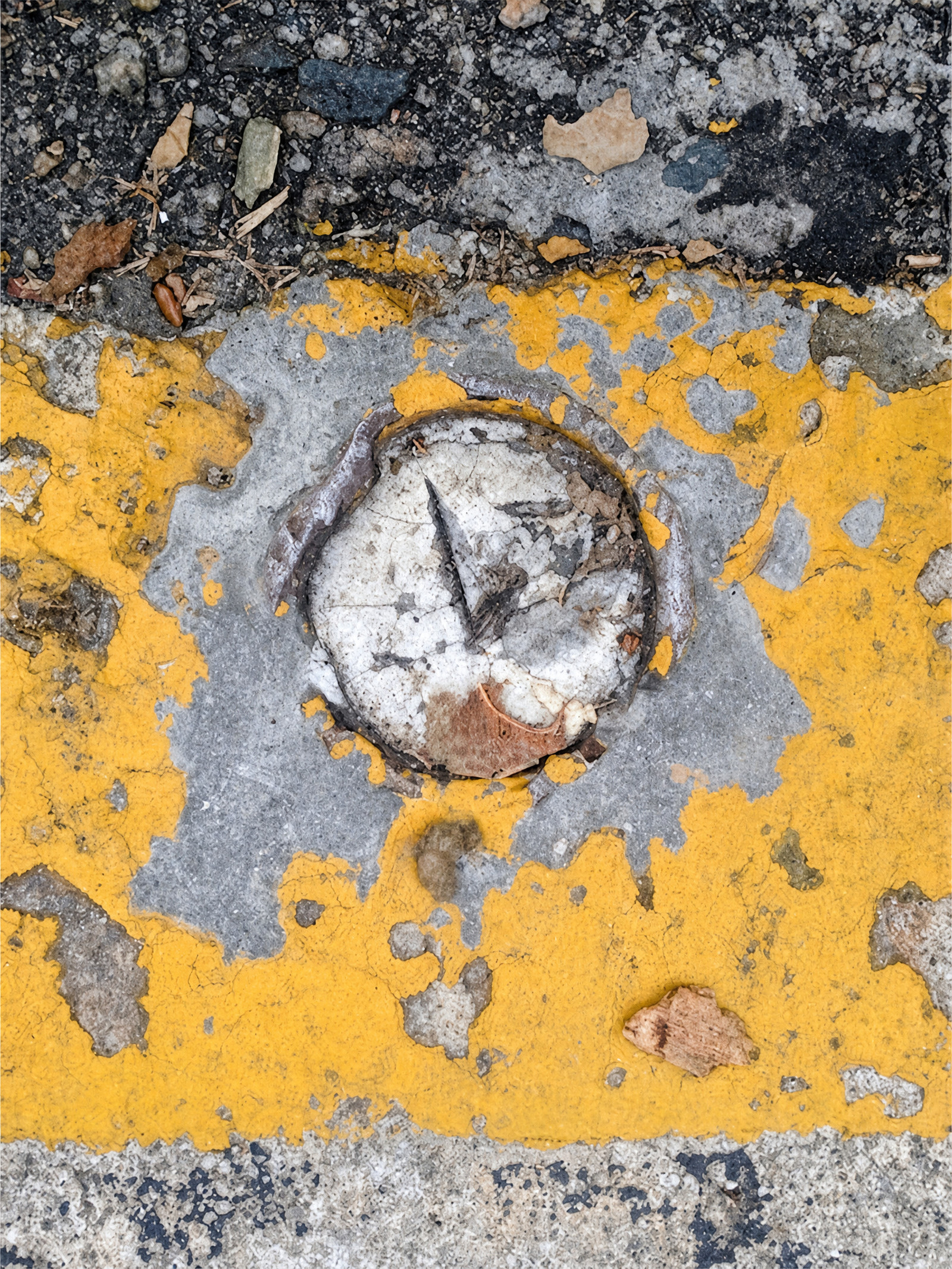
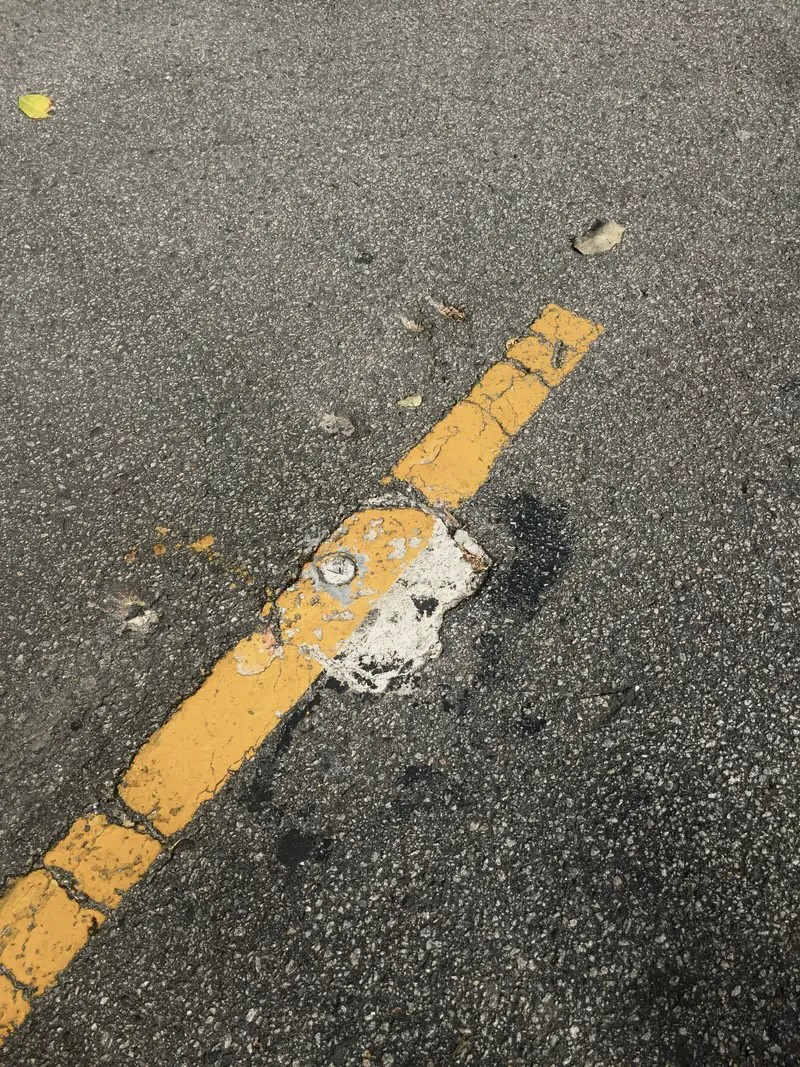
In a yellow parking stripe, a removed vertical metal tube left behind a circular fitting with two metal pointers. I noticed how the remaining elements resembled a watch face showing the time at 1:55.

Medium
Archival pigment print from an original digital photograph by Jussi Koria.
Dimensions
24 × 32 in / 60 × 80 cm
Edition
Signed limited edition of 20
The road marking where 1:55 was discovered
The found scene
1:55 discovery record and location map
Discovery Record
Making-of video

03

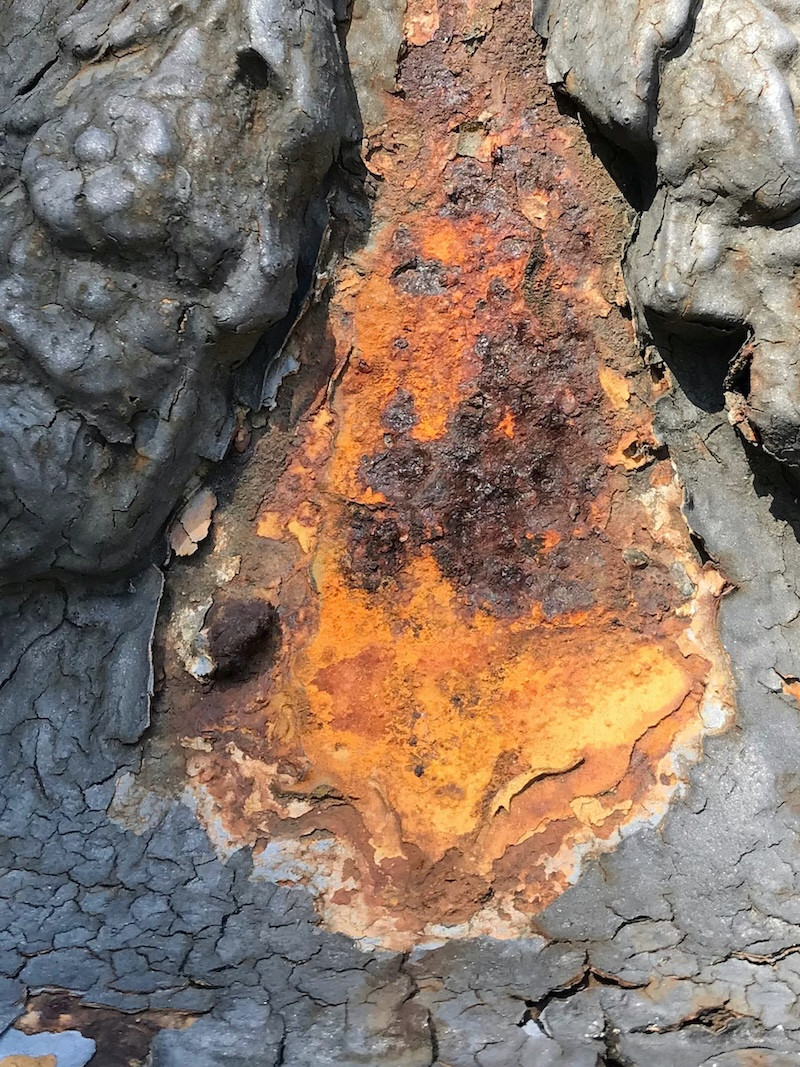
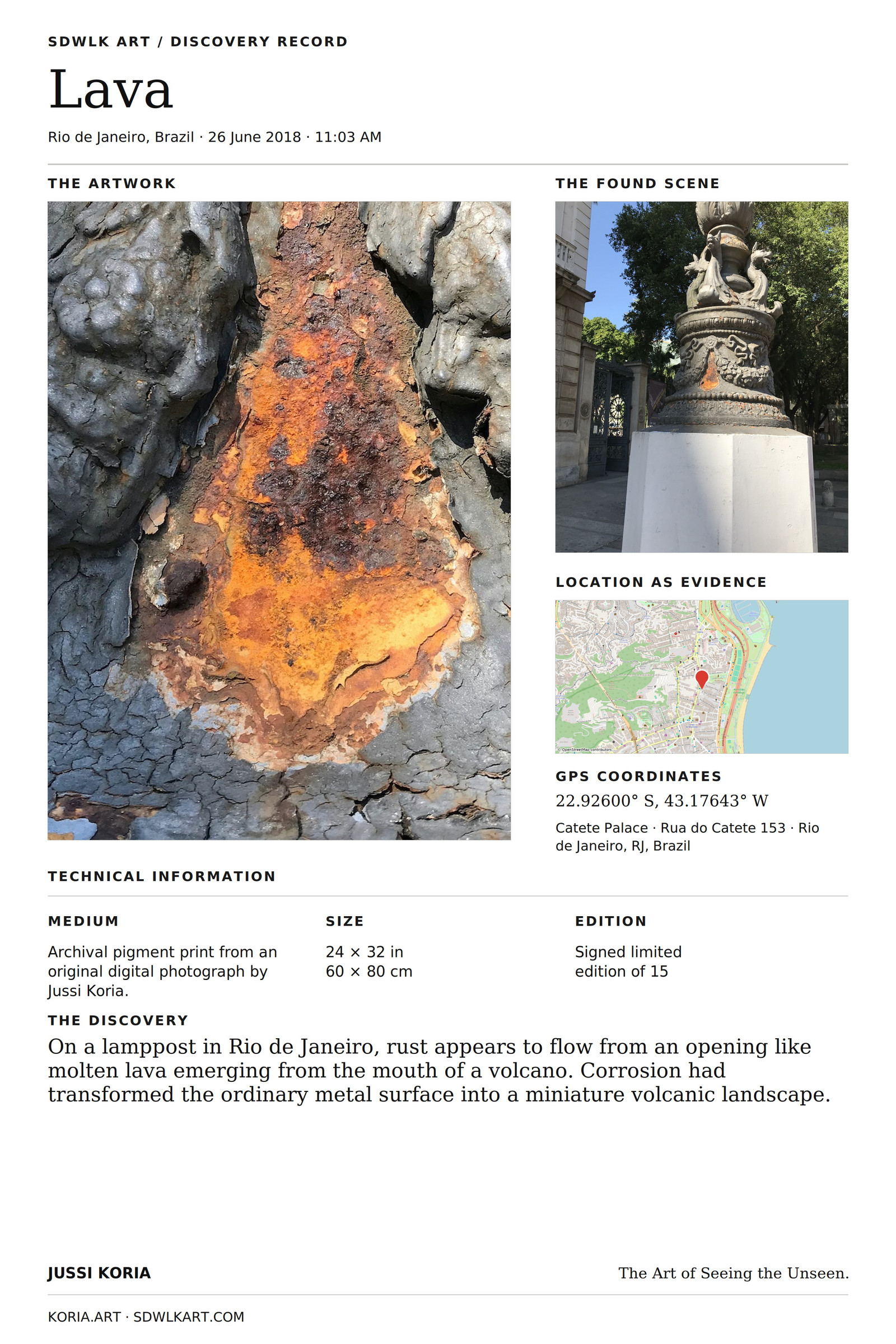
Lava

Rio de Janeiro · 2018
Lava by Jussi Koria
The artwork

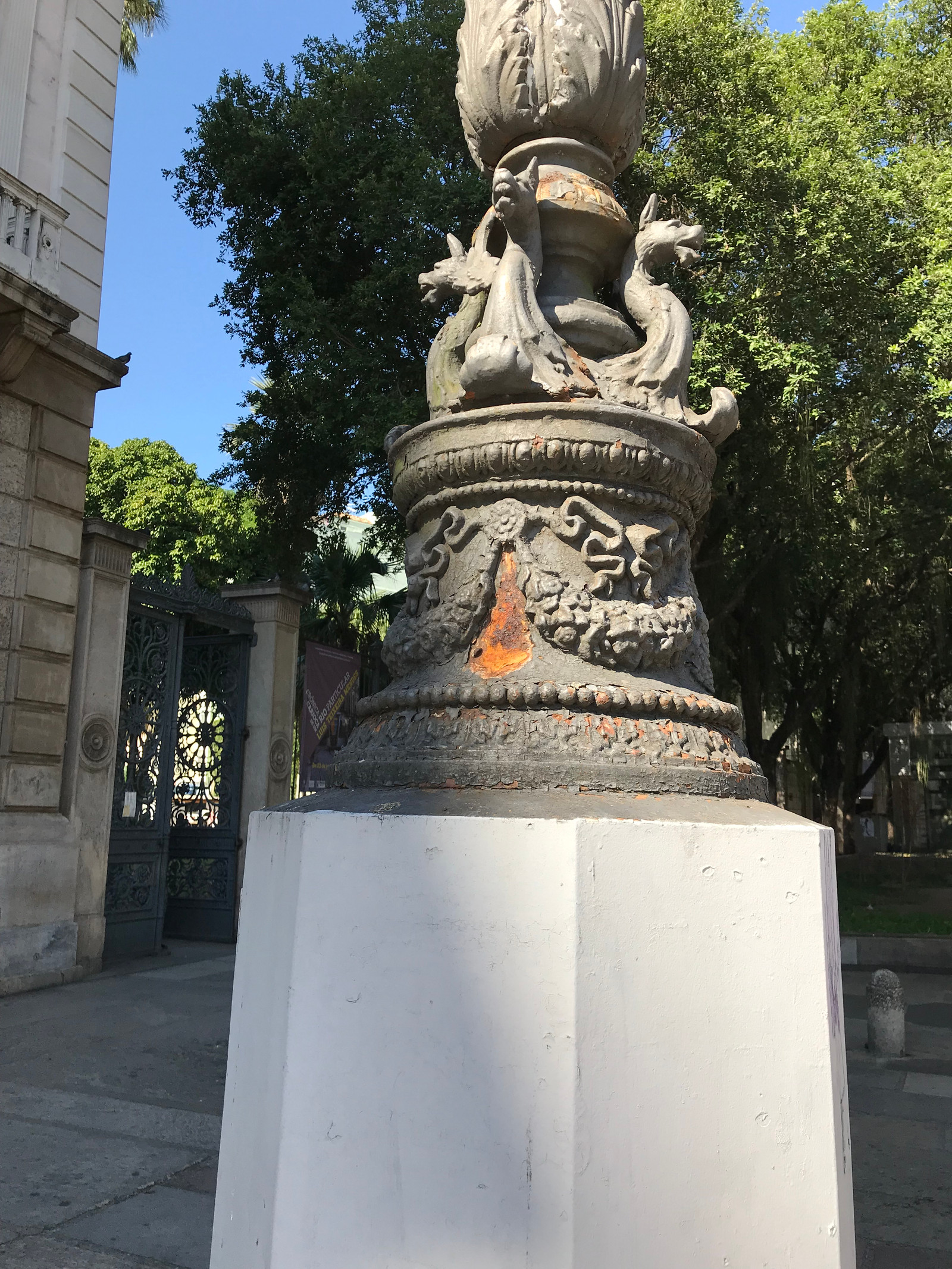
On a lamppost in Rio de Janeiro, rust appears to flow from an opening like molten lava emerging from the mouth of a volcano. Corrosion had transformed the ordinary metal surface into a miniature volcanic landscape.

Medium
Archival pigment print from an original digital photograph by Jussi Koria.
Dimensions
24 × 32 in / 60 × 80 cm
Edition
Signed limited edition of 15
The original monument where Lava was discovered
The found scene
Lava discovery record and location map
Discovery Record

04

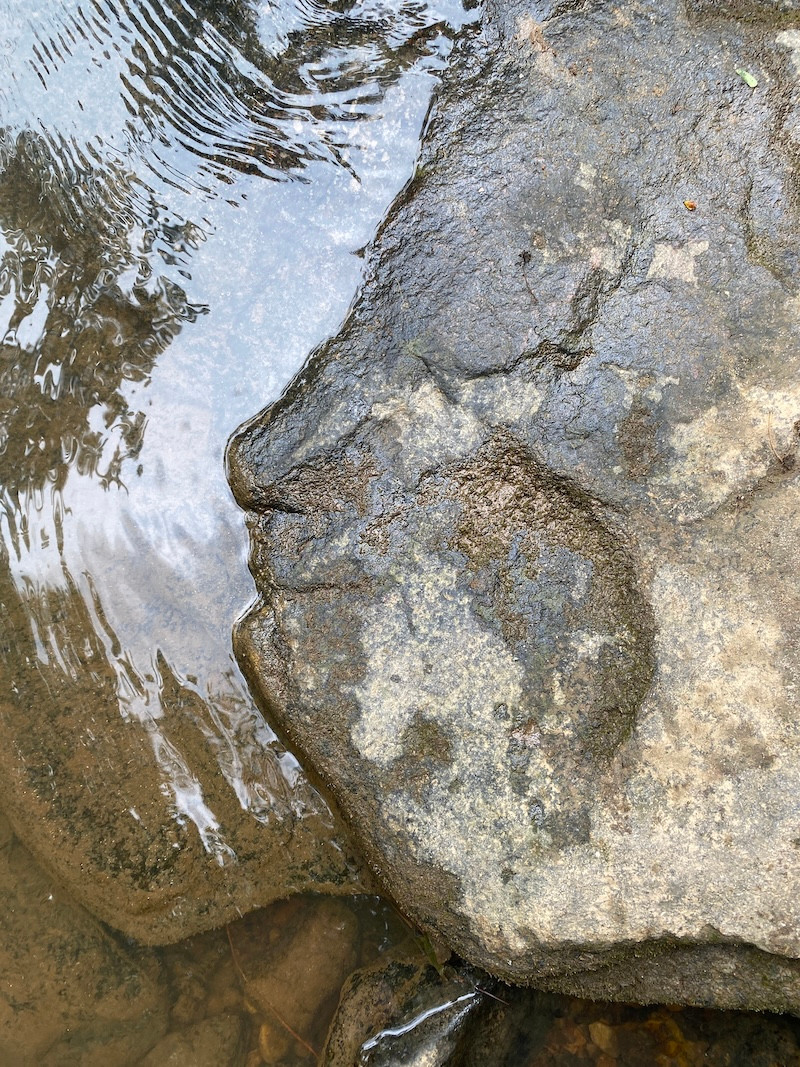
Xochipilli

Atlanta · 2021
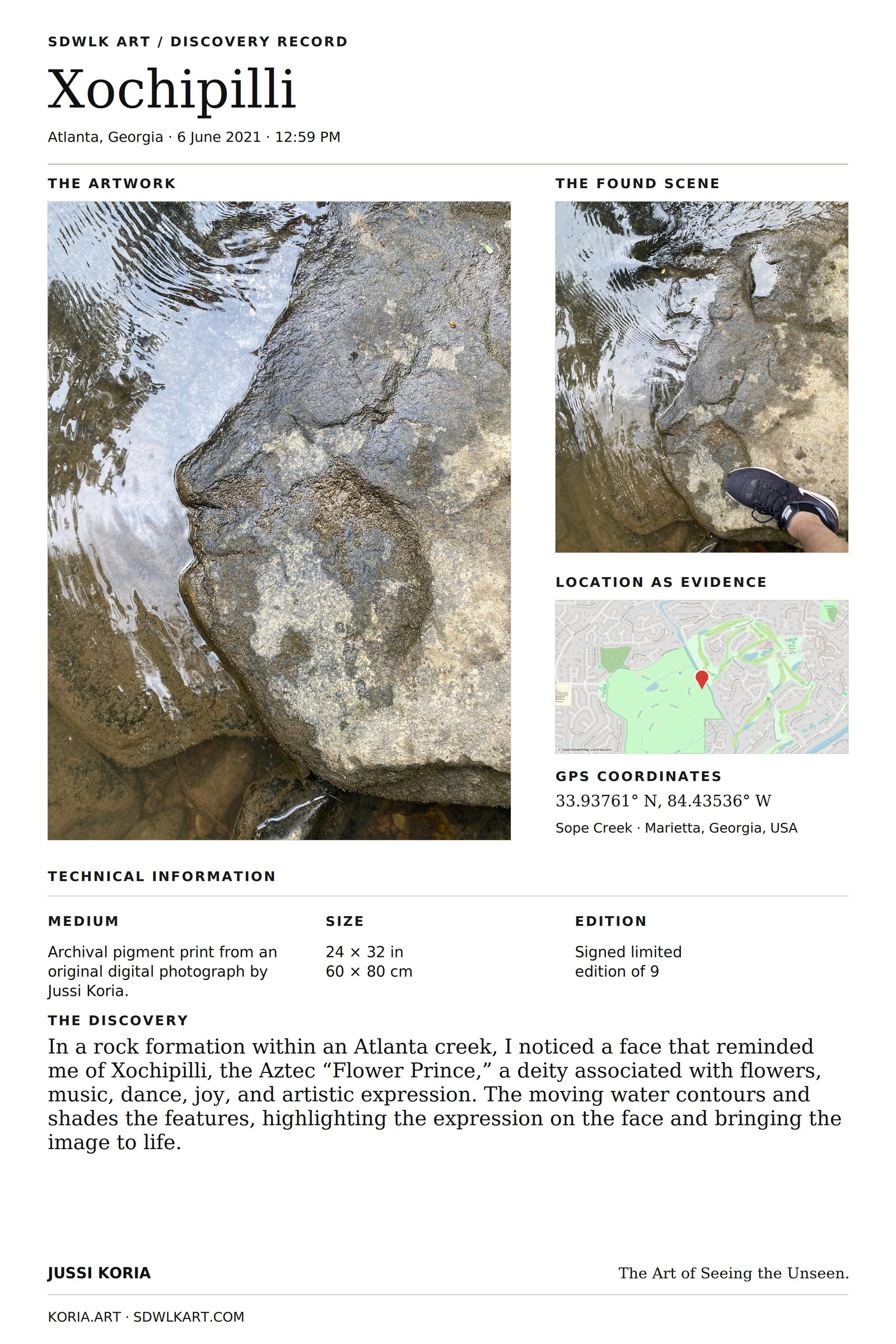
Xochipilli by Jussi Koria
The artwork

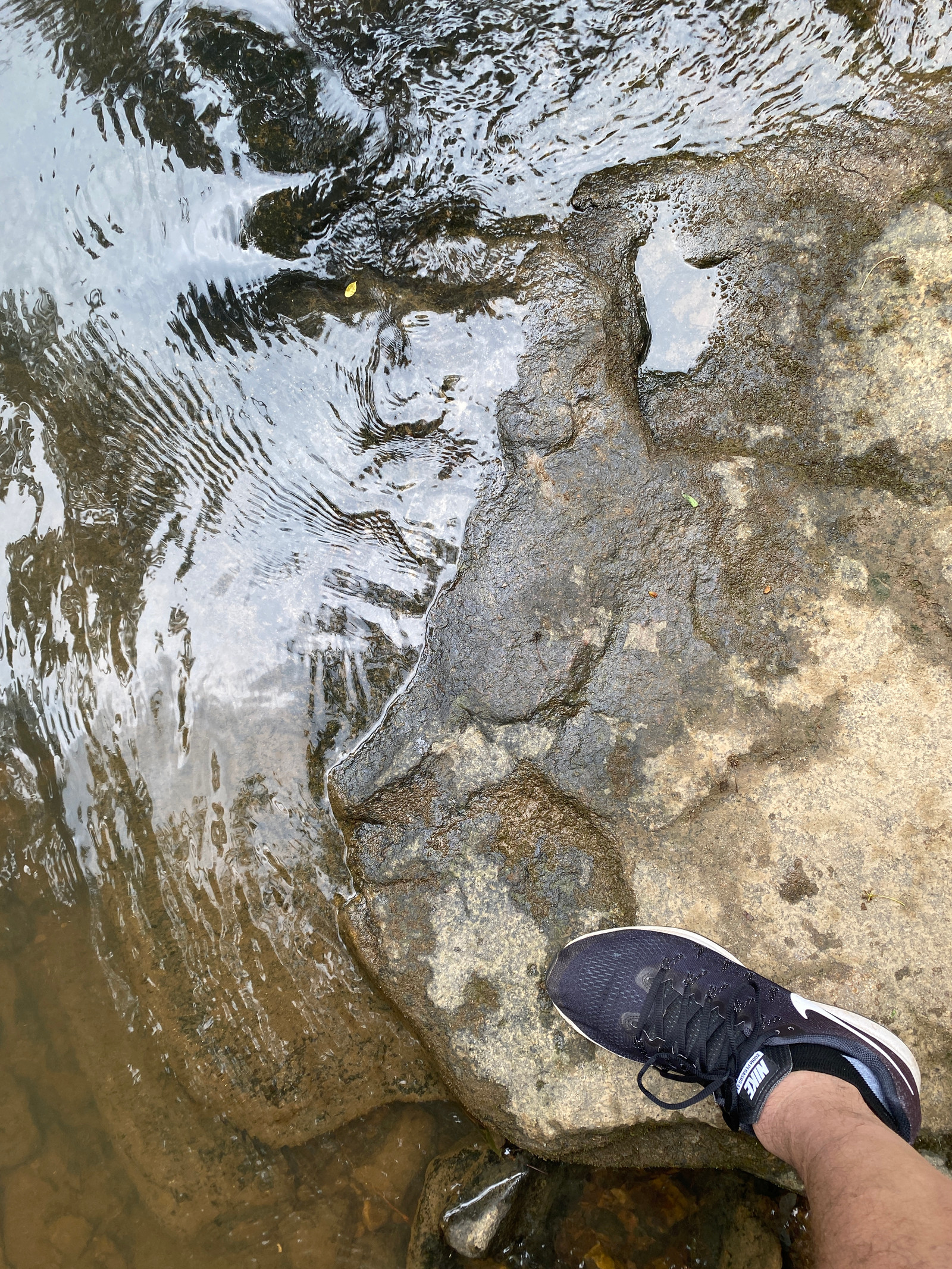
In a rock formation within an Atlanta creek, I noticed a face that reminded me of Xochipilli, the Aztec “Flower Prince,” a deity associated with flowers, music, dance, joy, and artistic expression. The moving water contours and shades the features, highlighting the expression on the face and bringing the image to life.

Medium
Archival pigment print from an original digital photograph by Jussi Koria.
Dimensions
24 × 32 in / 60 × 80 cm
Edition
Signed limited edition of 9
The streamside rock formation where Xochipilli was discovered
The found scene
Xochipilli discovery record and location map
Discovery Record

05

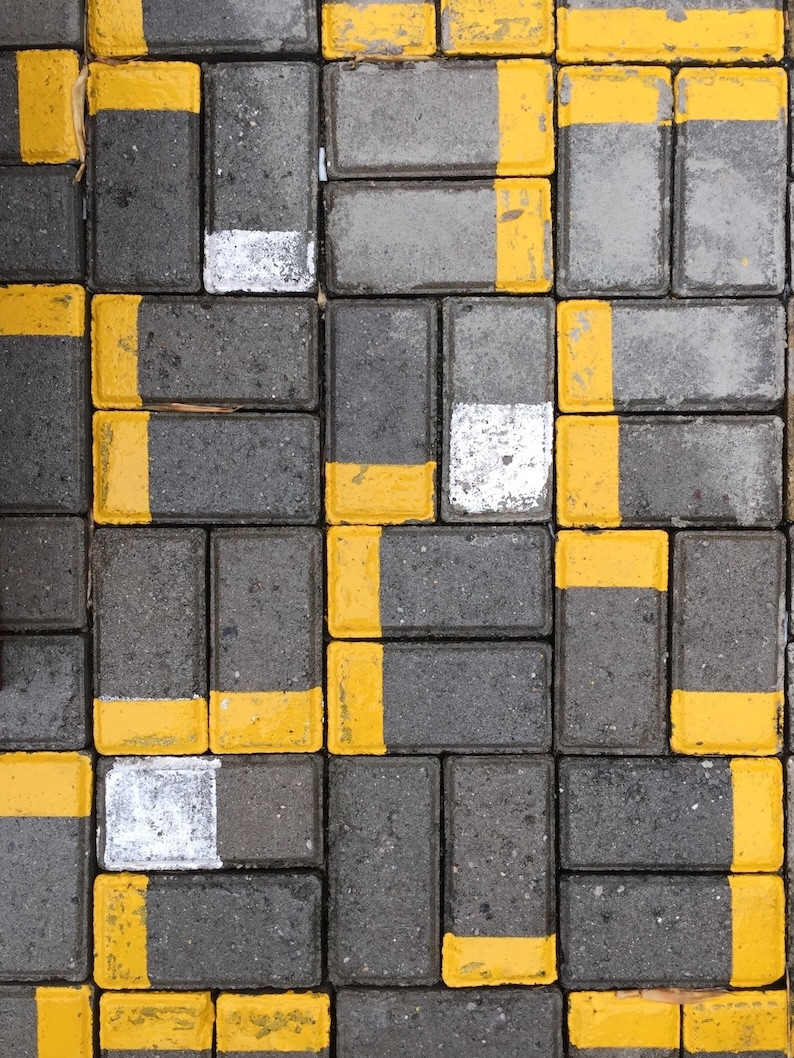
Video Game

Rio de Janeiro · 2017
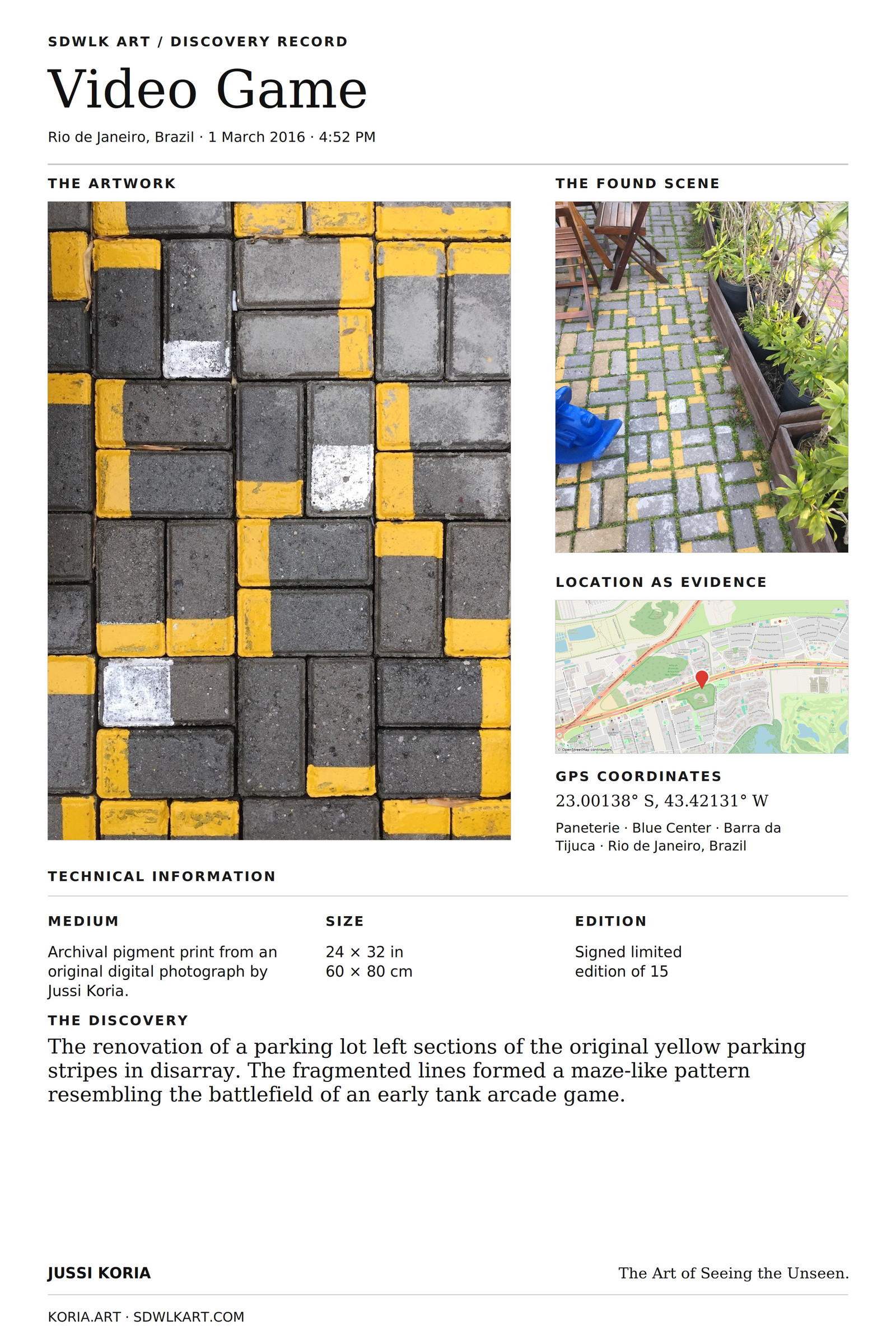
Video Game by Jussi Koria
The artwork

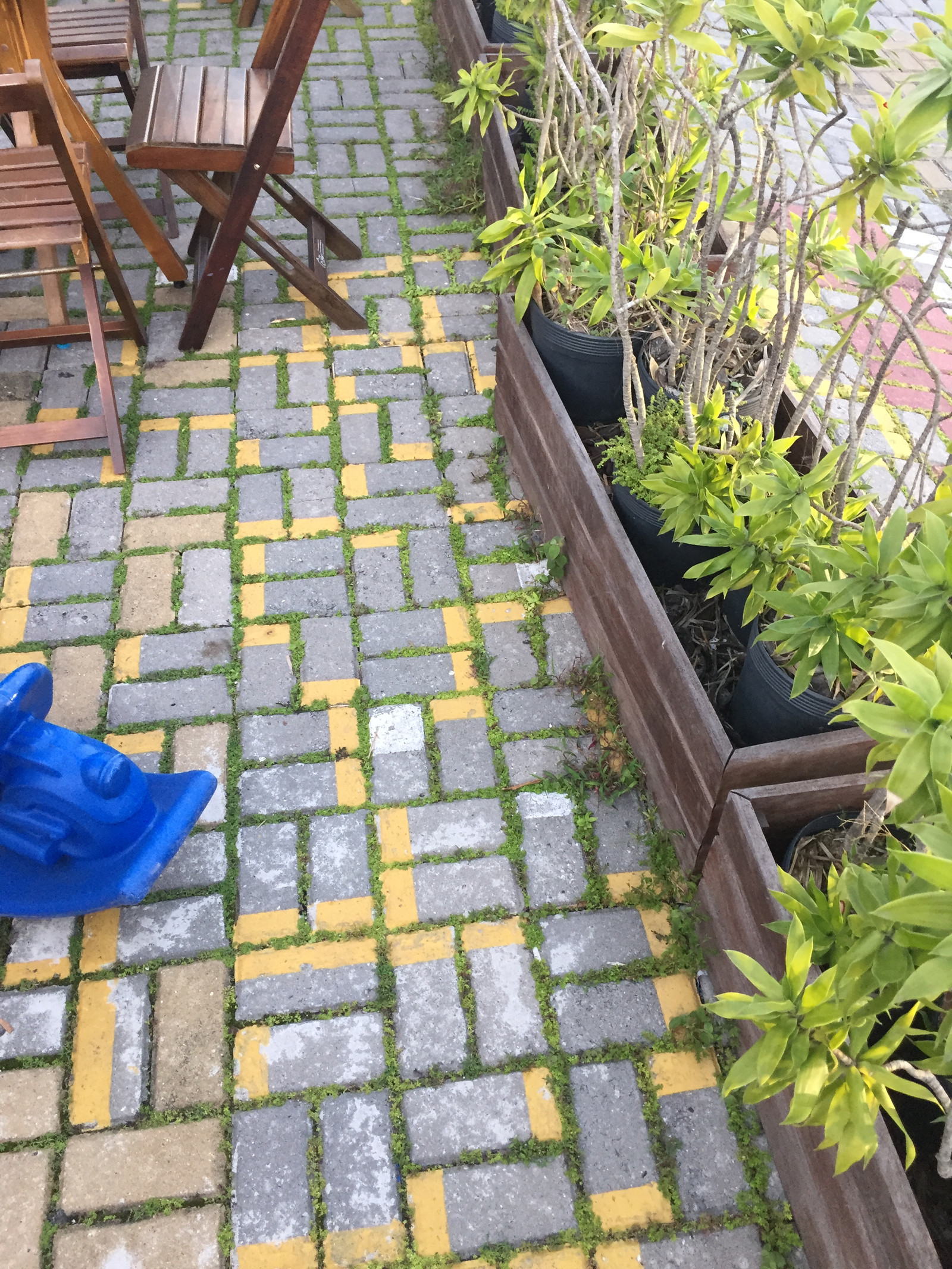
The renovation of a parking lot left sections of the original yellow parking stripes in disarray. The fragmented lines formed a maze-like pattern resembling the battlefield of an early tank arcade game.

Medium
Archival pigment print from an original digital photograph by Jussi Koria.
Dimensions
24 × 32 in / 60 × 80 cm
Edition
Signed limited edition of 15
The tiled patio where Video Game was discovered
The found scene
Video Game discovery record and location map
Discovery Record

06

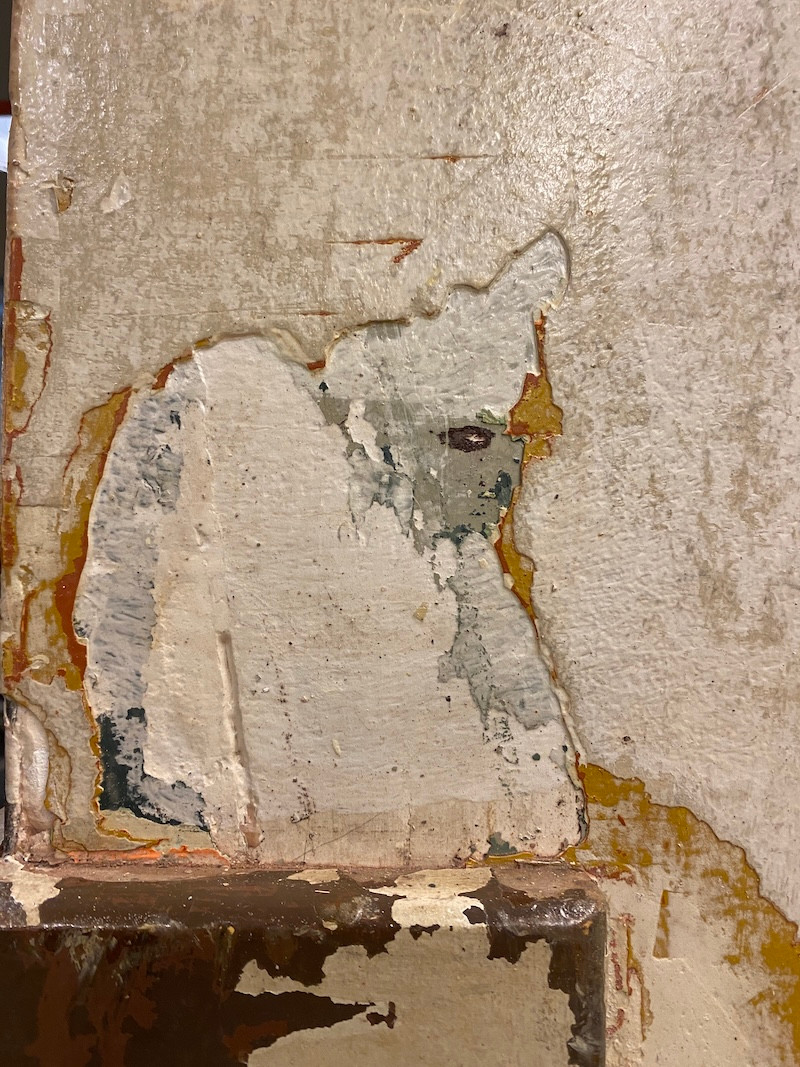
Maharaja

Atlanta · 2025
Maharaja by Jussi Koria
The artwork

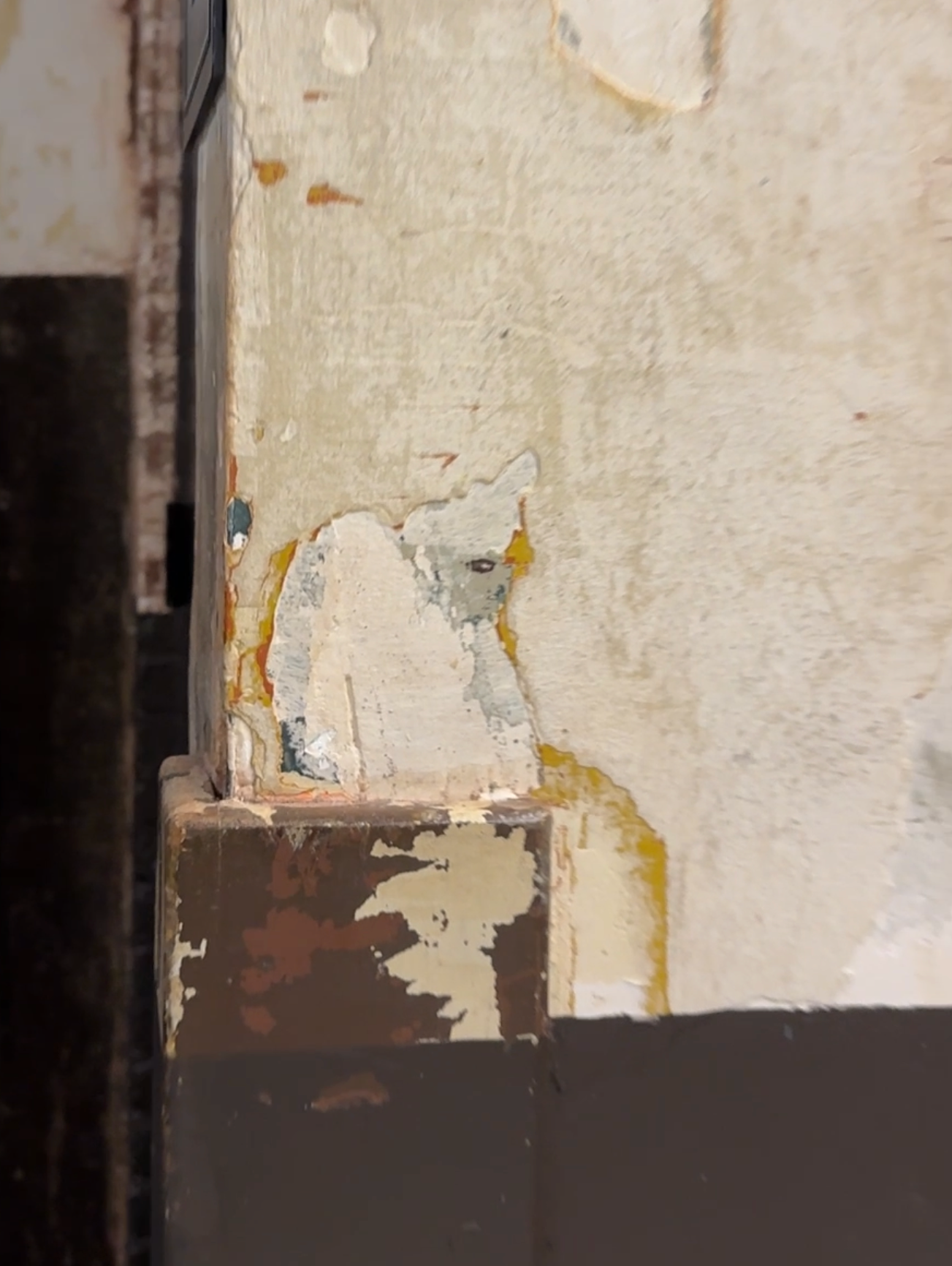
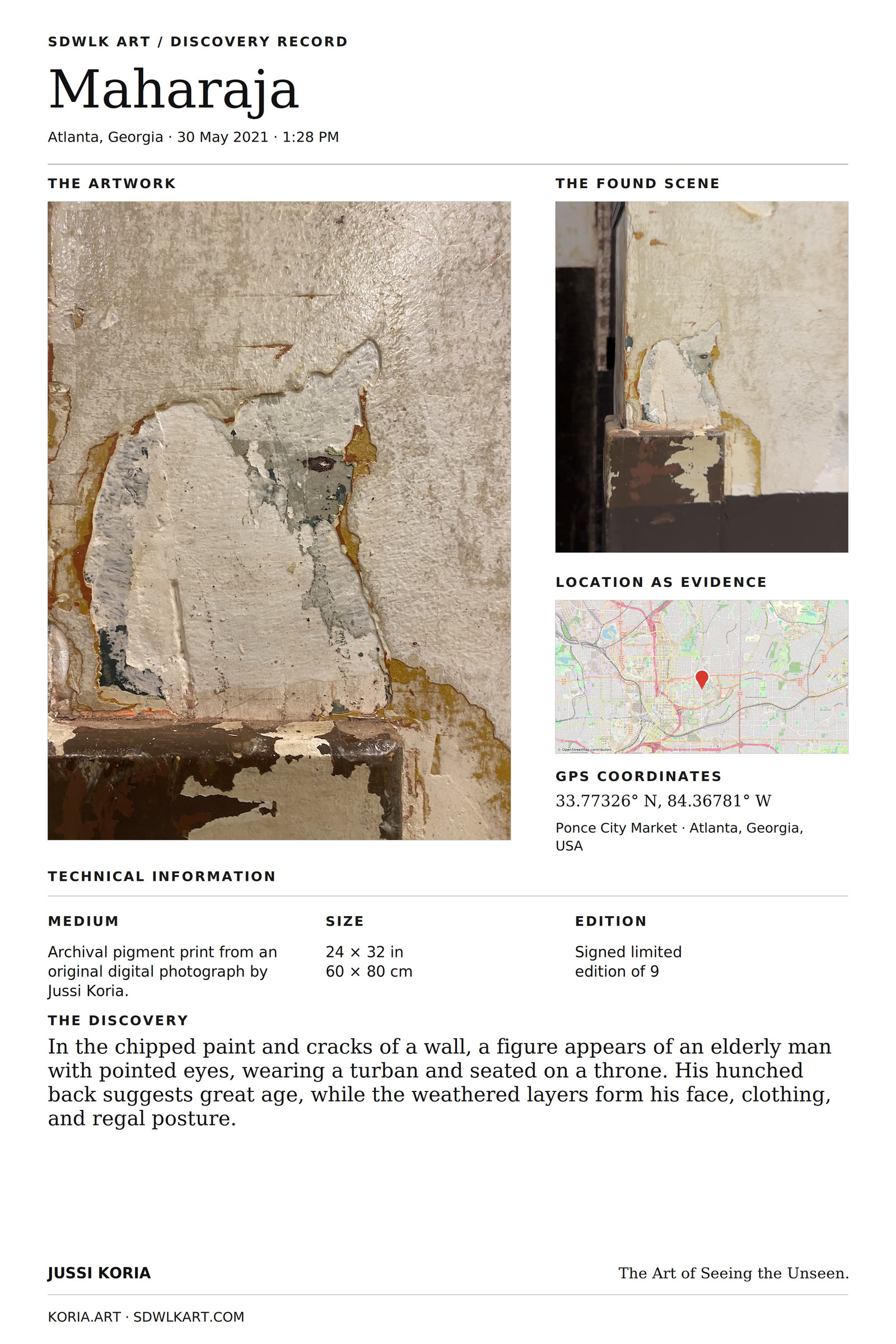
In the chipped paint and cracks of a wall, a figure appears of an elderly man with pointed eyes, wearing a turban and seated on a throne. His hunched back suggests great age, while the weathered layers form his face, clothing, and regal posture.

Medium
Archival pigment print from an original digital photograph by Jussi Koria.
Dimensions
24 × 32 in / 60 × 80 cm
Edition
Signed limited edition of 9
The original wall surface where Maharaja was discovered
The found scene
Maharaja discovery record and location map
Discovery Record
Making-of video

03 / Process

DiscoverFrameResignify

01The world is a canvas filled with accidental art. Look for intriguing images hidden in ordinary surfaces and overlooked by the casual eye.

02Use the camera to isolate the accidental composition and record its geographic location. The original scene is found, not staged.

03Name the artwork. The title invites the viewer to participate in the resignification of the found image.

“The photograph does not manufacture the artwork. It reveals the moment when the ordinary becomes impossible to ignore.”

04 / The story

A living archive of accidental art.

SDWLK ART is a living archive of accidental imagery: photographs of forms and compositions that existed before the artist recognized them as artworks. Rather than conventional street photography centered on people or events, the project focuses on unexpected compositions embedded in ordinary surfaces and environments.

Weather, wear, construction, human activity, and chance continuously alter the world around us, producing forms without intention or authorship. SDWLK ART begins when one of these forms is recognized as a composition. The scenes are found, not staged, altered, or assembled. Jussi Koria’s role is to notice the composition, determine where it begins and ends, and photograph it as encountered.

Each discovery is geolocated, preserving both the work and evidence of where it existed. The artistic transformation occurs through resignification: a title connects an accidental form to memory, language, emotion, or cultural association, inviting the viewer to see it anew. The title does not change the subject. It opens the work to interpretation.

The wider archive extends across at least 16 cities in 10 countries, revealing how different places produce their own accidental visual language. Streets, walls, paint, corrosion, and discarded materials become an evolving record of human activity, time, and chance.

The project asks what authorship can mean when creation begins with attention. Perhaps art does not always require making something new. Sometimes the creative act is seeing what was already there.
05 / Artist Bio

Jussi Koria

Portrait of artist Jussi Koria

Born in Imatra, Finland, Jussi Koria is an Atlanta-based photographic artist whose work explores perception, recognition, and the visual narratives embedded in everyday environments. Having lived in Finland, Spain, Portugal, Greece, Brazil, and the United States, he has developed a particular interest in how place, experience, and culture shape what people see in the same visual field.

Encouraged by the creativity of his parents and guided by a lifelong curiosity, Koria came to art later in life. In 2015, he began photographing accidental compositions found in streets and ordinary surfaces. Through framing and title, he draws attention to marks and materials that might otherwise go unnoticed, allowing familiar forms to take on new visual and cultural meaning. This process developed into SDWLK ART, an ongoing archive of found photographic compositions across cities and countries.

Koria’s work has been exhibited in Brazil and the United States. Through observation, photography, and title, he invites viewers to reconsider the familiar and recognize seeing itself as a creative act.

The Art of Seeing the Unseen